AWS vs Google Cloud (GCP) 2025: Pricing, Features & Comparison

Mughees
•
1 min read
Mughees
•
1 min read
Mughees Siddiqui
Co-Founder / AWS Cloud Architect

Mughees Siddiqui helps startups and engineering teams design scalable, secure, and cost-efficient solutions on AWS. His expertise spans AWS serverless architecture, generative AI, and modern frameworks to turn ideas into production-ready products.
Products
150+
Connections
500+
Experience
7+ Years
To share your Project Details
Table of contents
What Is Amazon Web Services (AWS)?
What Is Google Cloud Platform (GCP)?
GCP vs AWS: What’s Similar?Despite differences, AWS an
AWS vs Google Cloud: Key Differences
Google Cloud vs AWS: Security & Compliance Comparison
GCP vs AWS: Billing Comparison
AWS vs Google Cloud: Cost Comparison
AWS vs Google Cloud for Startups vs Enterprises
AWS vs Google Cloud for Developers and DevOps
AWS vs Google Cloud Certification Value
Which One Is Best for Your Business Needs? AWS or GCP
FAQs
Conclusion
Choosing the right cloud platform is one of the most critical decisions for any business. The two leading providers—Amazon Web Services (AWS) and Google Cloud Platform (GCP)—offer powerful solutions for startups, enterprises, and developers alike. Yet, the choice between AWS vs Google Cloud depends on budget, workload, security, and long-term strategy.
This guide provides a complete comparison of AWS and Google Cloud across features, pricing, performance, and use cases. By the end, you’ll know exactly how each platform stacks up and which is best for your business needs in 2025.
Amazon Web Services (AWS) launched in 2006 as the first major cloud computing platform. It quickly grew into the market leader, offering over 200 fully featured services across compute, storage, networking, databases, AI/ML, DevOps, and more.
AWS powers some of the largest companies in the world. Netflix relies on AWS for global video streaming, Airbnb uses it to scale millions of bookings, and Samsung leverages AWS for IoT solutions. Its reputation for reliability, flexibility, and enterprise-grade services makes it the top choice for large-scale businesses.
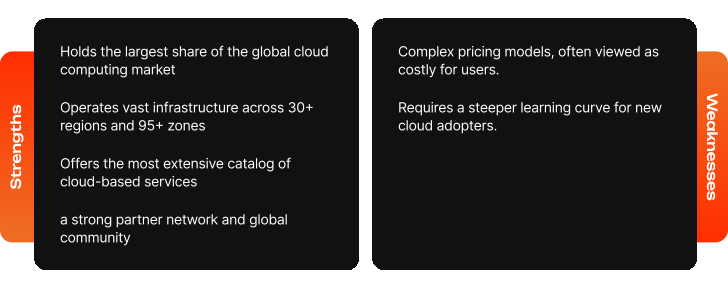
Strengths:
Largest cloud market share.
Global infrastructure in 30+ regions and 95+ availability zones.
Deepest service catalog.
Robust partner ecosystem and community support.
Weaknesses:
Pricing complexity, often criticized as expensive.
Steeper learning curve for new users.
Google Cloud Platform (GCP) is Google’s answer to AWS. Launched in 2008, it’s built on the same infrastructure that powers Google Search, YouTube, and Gmail, giving it a reputation for speed and innovation.
Google Cloud is widely recognized for its data analytics, AI, and machine learning tools. Companies like Spotify use GCP to deliver personalized music recommendations, PayPal leverages it for fraud detection, and Target uses GCP to optimize retail operations.
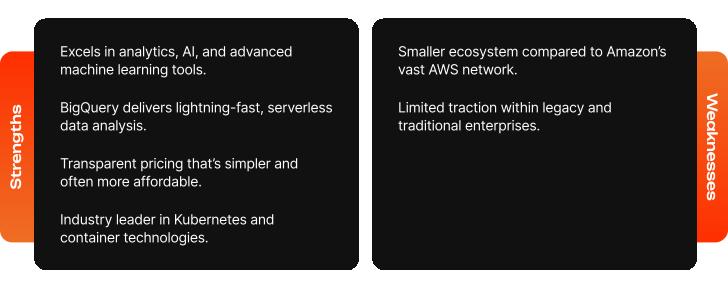
Strengths:
Market leader in data analytics and machine learning.
BigQuery, one of the fastest serverless data warehouses.
Simplified, often lower-cost pricing.
Superior Kubernetes and container orchestration support.
Weaknesses:
Smaller ecosystem compared to AWS.
Less enterprise adoption in traditional industries.
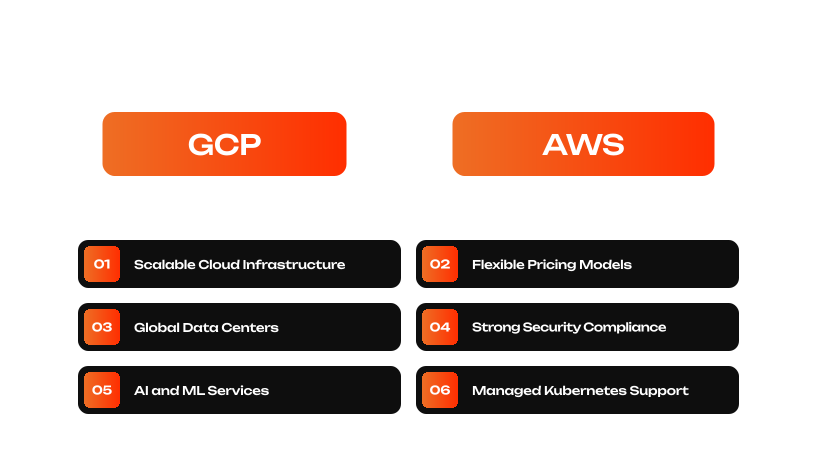
Despite differences, AWS and Google Cloud share core strengths that make them trusted cloud service providers.
Both AWS and GCP deliver elastic IaaS and PaaS solutions, allowing businesses to scale from small workloads to enterprise-grade deployments. Startups benefit from low-cost entry, while enterprises rely on global scalability.
Both providers follow pay-as-you-go pricing, with additional options for reserved or committed usage discounts. This flexibility helps businesses manage costs depending on workload size and duration.
AWS and Google Cloud operate extensive data centers worldwide. AWS leads with more regions, while GCP invests in high-performance subsea cables like the Equiano and Dunant systems to deliver low-latency networking.
Both platforms maintain compliance with major standards like ISO 27001, SOC 2, HIPAA, and GDPR. Enterprises in finance, healthcare, and government trust both providers for mission-critical workloads.
AWS and GCP are leaders in cloud AI innovation. AWS offers SageMaker for model training, while Google Cloud provides Vertex AI and TensorFlow, widely adopted in the developer community.
Both AWS and GCP provide managed Kubernetes (EKS for AWS, GKE for Google Cloud), enabling businesses to scale containerized applications seamlessly.
While they share similarities, their differences determine which is best for specific needs.
Feature | AWS | Google Cloud (GCP) |
|---|---|---|
Market Share | ~31% in 2025, largest provider | ~11% in 2025, third largest |
Strengths | Service depth, enterprise adoption, global reach | AI, ML, data analytics, cost efficiency |
Pricing | Complex, often higher | Simpler, often cheaper |
Networking | Advanced CDN (CloudFront), broad presence | Google’s private backbone, superior latency |
Databases | Aurora, DynamoDB, RDS, Redshift | BigQuery, Cloud Spanner, Firestore |
AI/ML | SageMaker, Rekognition, Polly | TensorFlow, Vertex AI, AutoML |
Best For | Large enterprises, hybrid workloads | Startups, AI-driven businesses |
Security is often the deciding factor in cloud adoption. Both platforms offer enterprise-grade security, but with slightly different approaches.
Both follow the Shared Responsibility Model. The provider secures infrastructure, while customers manage data, identity, and access.
AWS IAM: Granular policies, federation, and fine-grained permissions.
GCP Cloud IAM: Role-based controls, easier for developers.
AWS: Default encryption with KMS keys (customer or AWS managed).
GCP: Encrypts all data at rest and in transit by default, with customer-supplied keys option.
AWS: VPC, Shield, WAF, CloudFront security layers.
GCP: VPC Service Controls, Cloud Armor, BeyondCorp Zero Trust.
Both cover SOC 1–3, ISO, PCI DSS, HIPAA, GDPR, and FedRAMP. AWS holds slightly more certifications, appealing to regulated industries.
AWS: GuardDuty, Inspector, Macie for intelligent monitoring.
GCP: Security Command Center for centralized visibility.
AWS provides Organizations for multi-account governance. GCP enables hierarchical policy enforcement with Folders and Projects.
Pricing is one of the most debated topics in the AWS vs GCP discussion.
AWS uses on-demand, reserved instances, and spot pricing. GCP offers on-demand and committed-use contracts, often applying discounts automatically.
AWS: Free tier (12 months) with limited compute/storage.
GCP: $300 free credits valid for 90 days, plus always-free services.
AWS: Savings Plans and Reserved Instances save up to 72%.
GCP: Sustained use and committed use discounts, automatically applied.
Both provide dashboards and cost management consoles, though GCP’s interface is often considered more user-friendly.
GCP tends to be more predictable and transparent in pricing, while AWS can require deeper cost optimization tools.
AWS provides robust consolidated billing and multi-account tools. GCP focuses on simplicity and clarity for enterprises and SMBs.
Compute: GCP often 20–30% cheaper for sustained workloads.
Storage: AWS offers broader tiers, GCP cheaper for standard storage.
Networking: GCP’s egress costs are slightly lower.
Service | AWS | Google Cloud (GCP) |
|---|---|---|
Compute (vCPUs/hour) | $0.046 – $0.092 | $0.032 – $0.068 |
Storage (per GB/month) | $0.023 | $0.020 |
Database (Managed SQL) | $0.10 – $0.20/hr | $0.08 – $0.15/hr |
AI/ML Training | Higher baseline | Often lower, free tier credits |
Networking (per GB egress) | $0.09 – $0.12 | $0.08 – $0.11 |
Pricing is region-specific and subject to discounts.
Startups: Google Cloud is often the better choice thanks to affordable pricing, $300 credits, and strong AI/ML capabilities. Startups like Snapchat and Waze grew on GCP.
Enterprises: AWS is the go-to provider for financial institutions, healthcare, and global corporations requiring vast service coverage and compliance certifications. Companies like GE, Pfizer, and BMW trust AWS for mission-critical workloads.
Developers find both platforms appealing, but for different reasons.
AWS: Huge catalog of developer tools, including CodePipeline, CodeBuild, Cloud9, and integrations with third-party CI/CD.
GCP: Simplified developer experience, Cloud Build, Cloud Functions, and strong open-source support (especially Kubernetes and TensorFlow).
For DevOps teams, GCP offers faster container deployments, while AWS delivers deeper enterprise DevOps integration.
Both AWS and GCP certifications hold strong career value.
AWS Certified Solutions Architect is one of the most sought-after cloud certifications globally.
Google Professional Cloud Architect is recognized for validating expertise in modern cloud-native applications.
For enterprises, AWS certifications indicate breadth of services, while GCP certifications signal expertise in AI, ML, and data engineering.
The decision between AWS and Google Cloud depends on your strategy:
Choose AWS if: you need enterprise-grade reliability, global reach, and a massive service ecosystem.
Choose GCP if: you value cost savings, advanced AI/ML, and developer-friendly tools.
Best for Hybrid/Multi-Cloud: Many companies adopt both, using AWS for stability and GCP for AI/analytics innovation.
Both platforms are powerful. AWS offers a broader global infrastructure, while Google Cloud is strong in AI, data analytics, and cost efficiency. The choice depends on your business needs.
Yes, in many cases Google Cloud provides more cost-effective pricing models, especially for startups and developers, while AWS pricing is highly scalable for enterprises.
AWS provides a wider service catalog, stronger enterprise adoption, and global reach. GCP excels in machine learning, data analytics (BigQuery), and developer-friendly tools.
Both AWS and Google Cloud offer enterprise-grade security with encryption, compliance, and identity management. Security depends more on configuration and usage rather than the provider itself.
Google Cloud is considered superior in AI and ML, thanks to TensorFlow, Vertex AI, and its research background. AWS competes strongly with SageMaker and deep learning services.
Startups often prefer Google Cloud for its free credits, competitive pricing, and integration with open-source tools. AWS is better suited for companies looking to scale globally with enterprise features.
Yes, many businesses adopt a multi-cloud strategy — using AWS for core infrastructure and Google Cloud for AI, data analytics, and Kubernetes workloads.
AWS offers mature DevOps tools like CodePipeline and CodeBuild, while Google Cloud integrates tightly with Kubernetes, Docker, and open-source CI/CD workflows.
In the AWS vs Google Cloud debate, there’s no single winner. AWS dominates with market share, enterprise adoption, and service depth, while Google Cloud stands out with cost advantages, AI leadership, and developer simplicity.
The choice depends on your business size, workload type, and strategic goals. Many modern organizations adopt a multi-cloud strategy, using AWS and GCP together for maximum flexibility.
In 2025, the smartest move is not just choosing one, but leveraging the strengths of both AWS and Google Cloud to future-proof your cloud journey.
At GeeksVisor, we specialize in helping businesses plan, migrate, and optimize AWS environments. Our AWS consulting services ensure you choose the right architecture, manage costs effectively, and implement best practices for security and scalability. Whether you’re just starting your cloud journey or looking to optimize an existing AWS setup, our experts guide you every step of the way.
Modern Tech Stack
Inquiries
GeeksVisor
Follow us on Social Media


Copyright © 2026 All rights reserved by Geeksvisor